Parole
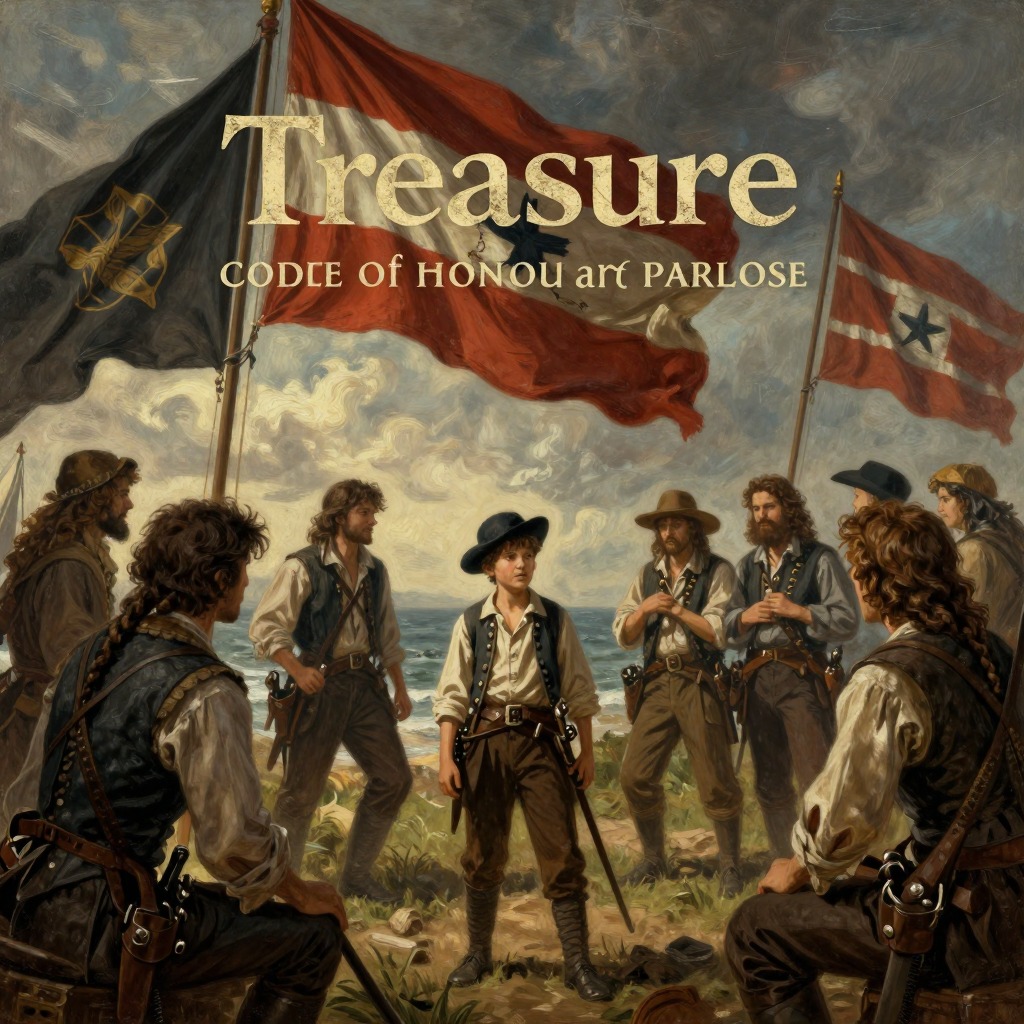
Parole, in the world of Treasure Island, is a formal promise of honor—a word of honor—that a captive gives to his captors, binding him not to attempt escape. When Jim Hawkins falls into the hands of Long John Silver and the mutineers, this concept becomes the central ethical and dramatic mechanism of his captivity, testing his integrity against his desperate desire to rejoin his friends and forcing him to navigate a treacherous moral landscape where a boy's word carries the weight of life and death.
The Extraction of the Pledge
The parole is first proposed by Long John Silver during a tense negotiation with Dr. Livesey, who has come to the stockade under a flag of truce to treat the wounded pirates. Silver, aware that Jim is a valuable hostage and that the doctor wishes to speak with the boy privately, devises a plan that will allow the conversation while keeping Jim securely in his power. He addresses Jim directly: "Hawkins, will you give me your word of honour as a young gentleman—for a young gentleman you are, although poor born—your word of honour not to slip your cable?" . The phrasing is crucial: Silver appeals to Jim's sense of himself as a gentleman, a status that transcends his humble birth, and frames the promise as a matter of personal honor rather than mere obedience. Jim, understanding the gravity of the request, "readily gave the pledge required" . With that single act, he transformed himself from a prisoner who might be expected to seize any chance of flight into a bound party to a contract, his own sense of self now tethered to the keeping of his word.
The Test of Integrity
The parole immediately becomes a source of profound moral tension. Dr. Livesey, once he has Jim alone on the other side of the stockade, urges him to break the promise and escape. "Whip over, and we'll run for it," he says, and when Jim reminds him, "Doctor, I passed my word," the doctor dismisses the objection: "I know, I know. We can't help that, Jim, now. I'll take it on my shoulders, holus bolus, blame and shame, my boy; but stay here, I cannot let you. Jump! One jump, and you're out, and we'll run for it like antelopes" (E01265–E01266). The doctor, a man of authority and experience, is willing to assume the moral burden of breaking the parole, but Jim refuses. His reply is firm and principled: "No. You know right well you wouldn't do the thing yourself—neither you nor squire nor captain; and no more will I. Silver trusted me; I passed my word, and back I go" . In this moment, Jim asserts a code of honor that transcends the immediate practical advantage of escape. He holds himself to a standard he believes the adults he respects would also uphold, and he chooses to return to the pirate camp, knowing the danger, rather than betray his given word.
Consequences and Narrative Significance
Jim's adherence to his parole has far-reaching consequences. It deepens Silver's trust in him, leading the sea-cook to protect Jim from the more violent mutineers and to form a secret alliance with him. It also allows Jim to remain in the enemy camp, where he overhears crucial information and witnesses the deposition of Silver through the Black Spot. More profoundly, the parole episode crystallizes Jim's moral development. Throughout the novel, he has been a boy of impulsive courage—hiding in the apple barrel, sneaking ashore, cutting the Hispaniola adrift—but here he demonstrates a different kind of bravery: the courage to keep a promise even when it costs him his freedom and puts his life at risk. The parole, then, is not merely a plot device but a rite of passage, marking Jim's transition from a clever child who acts on instinct to a young man who understands that honor is a currency that cannot be spent lightly. It is a rule of conduct that, in the lawless world of Treasure Island, becomes the foundation of Jim's moral identity.